
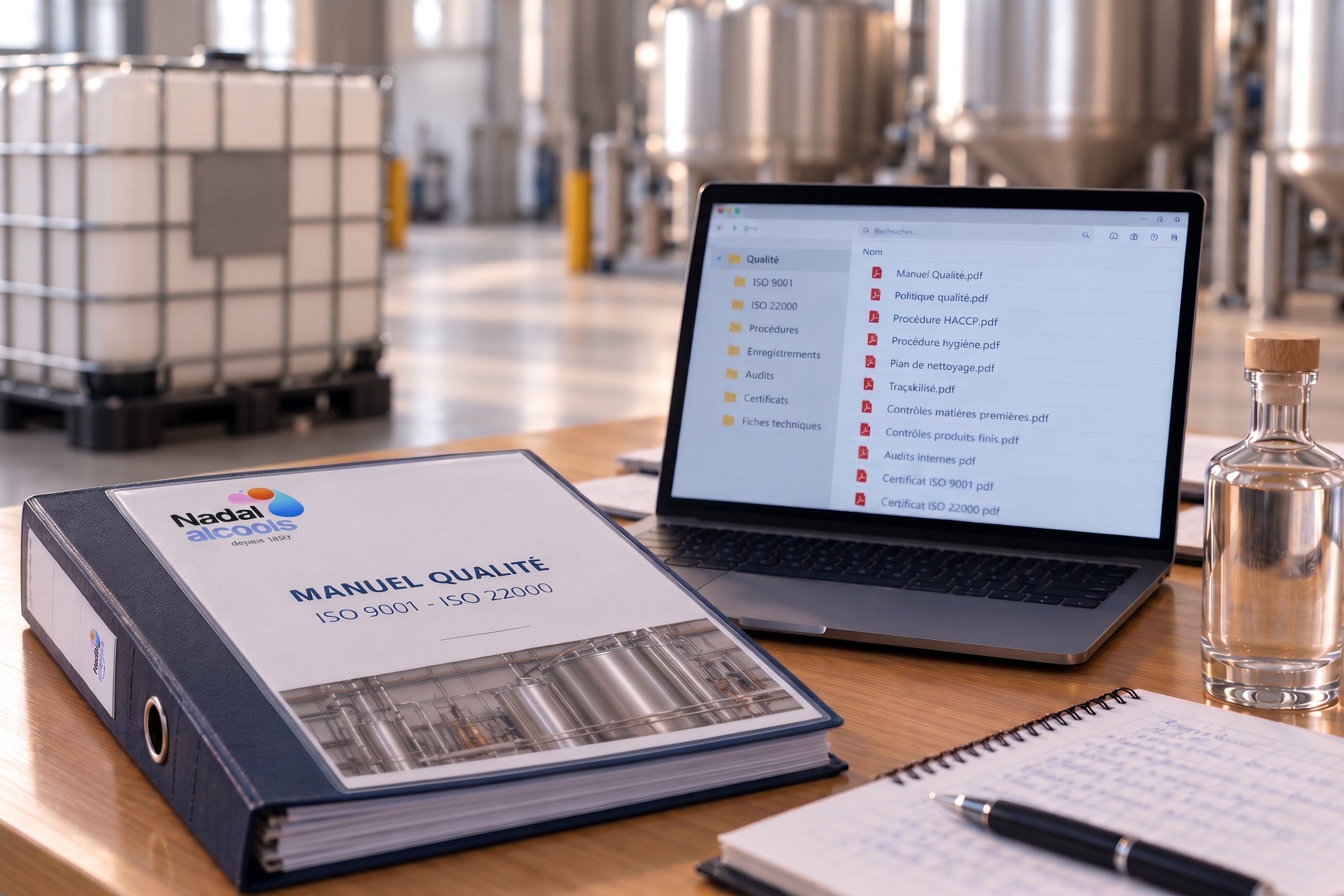
At Nadal Alcools, these certifications reflect both the way our company is organized and the wide range of applications our products are intended for. Our range notably includes organic neutral alcohols, raw materials certified or approved under the COSMOS standard, and a kosher-certified extra neutral alcohol.
Nadal Alcools is also ISO 9001 certified for its entire organization and ISO 22000 certified for food safety management. These two certifications cover our working methods and management systems, not the individual certification of specific products.
However, these labels do not cover the same requirements, nor necessarily the same products. Some relate directly to a product or its origin. Others concern the company’s organization, its activities or the control of its processes.
Understanding their scope makes it easier to identify the alcohol and the documents that match your specifications.
Organic certification: a controlled supply chain
For an ethyl alcohol of agricultural origin, organic certification covers the origin of the raw materials as well as the traceability of processing and marketing operations.
The operator is inspected by a certification body. The certificate specifies the activities, product categories and products included in its scope.
The Ecocert certificate of Nadal Alcools currently covers three product categories:
- organic extra neutral alcohol at 96% vol.;
- organic extra neutral alcohol at 90% vol.;
- organic neutral wine alcohol at 96% vol.
These products fall into the category of processed agricultural products intended for human consumption. The certificate covers the processing and export activities of Nadal Alcools.
Two organic origins in the Nadal Alcools range
The organic 96% extra neutral alcohol offered by Nadal Alcools is made from organic wheat of European origin. Rectification gives it the neutrality required for food applications and for products in which the alcohol must not alter the aromatic profile of the finished product.
Organic 96% neutral wine alcohol has a different origin. It is made from French organic wine materials: pomace, lees and wine. This food-grade product is particularly suited to projects where a wine or French origin is a selection criterion.
Organic certification alone, however, does not tell you everything about the technical characteristics of the alcohol. It does not automatically indicate its degree of neutrality, its analytical limits or its suitability for a particular formulation. These points must be checked in the technical data sheet and, where necessary, in the certificate of analysis.
Nor does using a certified organic alcohol automatically make the finished product organic. The finished product must meet its own rules for composition, processing, inspection and labeling.
Organic alcohol and bioethanol: two different concepts
The terms “organic alcohol” and “bioethanol” are sometimes confused.
An organic alcohol is covered by a certification issued under the rules that apply to organic farming. Its raw material, processing and marketing chain are all part of an inspection system.
The term bioethanol generally refers to ethanol produced from biomass. Here, the prefix “bio” refers to its plant or biological origin, not necessarily to an organic farming certification.
The word “bioethanol” alone therefore does not allow a product to be presented as certified organic. Only a valid certificate can confirm which products are actually covered.
COSMOS: telling a certified raw material from an approved raw material
COSMOS is an international standard for natural and organic cosmetic products and for the raw materials used to make them.
In this field, it is essential to distinguish a COSMOS CERTIFIED raw material from a raw material that is simply approved for use in certain COSMOS formulations.
Nadal Alcools’ certified raw materials
The COSMOS certificate of Nadal Alcools currently covers two raw materials:
- Cosmenol® Organic;
- organic COSMOS agricultural extra neutral alcohol.
Cosmenol® Organic is an organic wheat extra neutral alcohol, partially denatured with 0.1% TBA and 10 ppm denatonium benzoate. The COSMOS certificate states a content of 99.87% organic chemically processed agricultural ingredients.
This product is intended for the cosmetics and perfume industries. Because it is denatured, it is unfit for human consumption.
Organic COSMOS agricultural extra neutral alcohol is also listed on the certificate, with 100% organic chemically processed agricultural ingredients.
Raw materials approved for COSMOS NATURAL
Nadal Alcools also holds an approval certificate covering:
- conventional 96% agricultural extra neutral alcohol;
- conventional Cosmenol®, denatured with 0.1% TBA and 10 ppm denatonium benzoate.
These two products can be used as solvents in products under COSMOS NATURAL, under the conditions set out in the standard.
This approval is not a certification of the raw material. An approved product must therefore not be presented as a COSMOS-certified organic raw material.
The COSMOS status of the alcohol is one part of the formulation file, but it does not automatically certify the final cosmetic product. The whole formula, the process, the packaging and the labeling must also meet the requirements of the standard.
Kosher certification: a specific product and a defined scope
Kosher certification attests that a product complies with the rules of kashrut, within the scope defined by the authority that issues the certificate.
The review may cover raw materials, processing aids, equipment, the site and manufacturing conditions. It is not a simple declaration of origin and does not mean the product has been “blessed.”
The certificate currently published by Nadal Alcools covers its 96% extra neutral ethanol of agricultural origin. It attests that this product is kosher Pareve, not for Passover. The certificate also mentions the inspection of the Le Boulou site and the control of the raw materials used.
This certification can meet specifications that require a kosher raw material. It does not, however, say anything about the organic origin of the alcohol, its neutrality or its analytical characteristics.
The certificate should always be checked before ordering to confirm the product covered, its classification and its validity period.
ISO 9001: the quality organization of Nadal Alcools
ISO 9001 is an international standard for quality management. It does not certify an alcohol directly: it assesses how a company organizes and controls its activities.
Nadal Alcools is ISO 9001 certified for its entire organization. The scope covers the head office in Argelès-sur-Mer, the warehouse in Le Boulou and our alcohol sales activities.
This certification notably covers:
- the organization and monitoring of processes;
- document control;
- the traceability of operations;
- the handling of nonconformities;
- the follow-up of complaints;
- continuous improvement.
For a buyer, ISO 9001 provides assurance about the quality organization of Nadal Alcools and the consistency of its working methods. It does not mean, however, that all the alcohols sold have the same characteristics or hold the same product certifications.
Each product keeps its own specifications, origin, regulatory status and documents.
ISO 22000: food safety applied to Nadal Alcools’ activities
ISO 22000 covers food safety management. It sets out the requirements for identifying, preventing and controlling hazards that could affect the safety of food products.
Like ISO 9001, ISO 22000 is a certification of the management system, not an individual certification of each alcohol.
Nadal Alcools is ISO 22000 certified for its activities related to food-grade alcohols. This organization is based in particular on the principles of the HACCP method, traceability, hazard control, compliance with hygiene rules and incident management.
In the Nadal Alcools range, this approach applies to alcohols intended for the food and spirits industries, including:
- 96% agricultural extra neutral alcohol;
- organic extra neutral alcohol;
- neutral wine alcohol;
- organic neutral wine alcohol;
- Pur-Spirit®, French wheat extra neutral alcohol;
- white and aged rums.
These products are available in various professional packaging sizes depending on the volumes required.
ISO 22000 certification does not, however, remove the need to check that the selected alcohol is actually intended for food use. A denatured alcohol remains unfit for human consumption, even when it is sold by an ISO 22000 certified company.
Finally, while ISO 22000 certification specifically concerns food safety, the working methods put in place within this framework – hygiene, inspections, traceability and risk management – benefit all of Nadal Alcools’ activities.
Several certifications, but different scopes
A single company can be ISO 9001 and ISO 22000 certified while offering alcohols covered by specific certifications or approvals.
At Nadal Alcools, the scope varies by product:
- organic extra neutral alcohols at 90% and 96% and organic neutral wine alcohol at 96% are covered by the Ecocert organic certificate;
- Cosmenol® Organic and organic COSMOS agricultural extra neutral alcohol are covered by the COSMOS certificate;
- conventional 96% agricultural extra neutral alcohol and conventional Cosmenol® hold an approval for certain COSMOS NATURAL applications;
- 96% extra neutral ethanol of agricultural origin is covered by the kosher certificate currently published;
- ISO 9001 and ISO 22000 cover the management systems applied to Nadal Alcools’ activities.
A logo or a general statement is therefore not enough to confirm that a specific product is covered. The corresponding certificate or approval must be clearly linked to the product ordered.
Which documents should you check before choosing an alcohol?
Certification is only one part of the documentation.
To confirm organic origin, consult the valid organic certificate and check that the product you are looking for appears in its product list.
For a cosmetic formulation, you need to identify the exact COSMOS status of the raw material: certification or simple approval, COSMOS ORGANIC or COSMOS NATURAL.
When kosher certification is required, the certificate must match the product requested, the site concerned and the manufacturing or delivery period.
ISO certificates provide information about the company’s organization and activities. They must be distinguished from product-specific documents:
- the technical data sheet, which presents the main characteristics of the product;
- the safety data sheet, which sets out the hazards and the applicable precautions;
- the certificate of analysis, which presents the results for a given batch;
- any certificates of origin, compliance or denaturation that may be requested.
None of these documents replaces the others. They answer different questions and should be reviewed according to the intended use.
Documents available for every project
Choosing a certified alcohol depends on the intended use, the requirements of your specifications and the exact scope of the certifications. A single company may offer products holding different certifications, without these necessarily applying to its entire range.
Beyond organic, COSMOS, kosher, ISO 9001 and ISO 22000 certifications, you should also take into account the origin of the alcohol, its alcoholic strength, its neutrality, any denaturation and the documents required for its use.
Do you need an alcohol that meets specific requirements? Tell our sales team about your application, the certifications you are looking for and the documents you need. We can then point you to the products best suited to your project.