
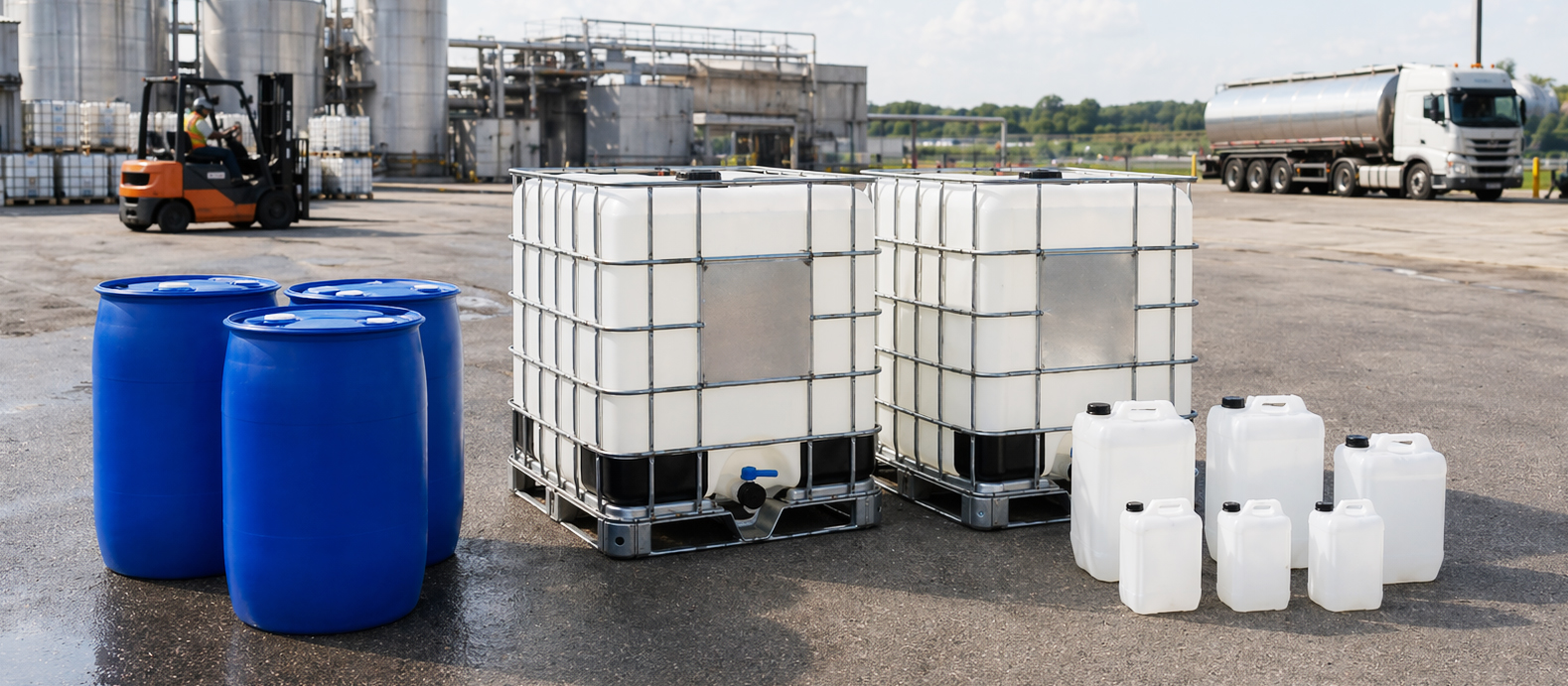
The container: a solution for flow rather than storage
It is crucial to distinguish the transport function from long-term storage. Polymer packaging, such as cans, plastic drums or IBC liners, is first and foremost designed for transport, handling and protecting the product throughout its logistics journey. However, it cannot be considered a universal long-term storage solution. For long-term storage, materials such as stainless steel or glass remain the benchmarks. Plastic should therefore be used as part of controlled stock rotation.
The material: choosing stability
High-density polyethylene (HDPE) is the reference material for our rigid containers. This choice is based on its ability to preserve the properties of ethanol without structural degradation of the packaging. Using specific polymers (semi-high molecular weight grades) provides mechanical resistance suited to the impacts and thermal pressure variations that are common during transport.
Food contact: a shared responsibility
Suitability for food contact is a major point of vigilance. All packaging intended for alcohol must meet the requirements of European regulations 1935/2004 and 10/2011. This compliance is verified by overall migration tests using simulants (ethanol, acetic acid, oil). We select packaging that meets strict requirements on this point, with particular attention to:
- bisphenols,
- phthalates,
- PFAS,
- MOSH/MOAH.
All of these requirements are part of our ISO 22000 certification and our HACCP monitoring. These tests aim to ensure that any transfer of constituents from the plastic into the liquid stays within regulatory limits, thus preserving the quality of the finished product.
ADR transport: approval comes first
Since alcohol is classified as a dangerous good (Class 3), its transport is strictly regulated. Each packaging model (can or IBC) must hold a valid UN approval. This approval certifies that the container has passed rigorous resistance tests:
- low-temperature drop,
- stacking under load,
- hydraulic pressure.
It is an essential prerequisite for transport that complies with the applicable requirements (ADR/IMDG).
Formats for every use
The can (5L to 20L)
An agile format, it is particularly well suited to laboratories, sampling, or production units with fractional needs. It stands out for its ease of handling, its standardized DIN neck and its sight line for checking the level at a glance.
The drum (200L)
It bridges the gap between craft production and industry. The drum offers robust protection for intermediate volumes while remaining maneuverable with standard handling equipment (hand truck or drum clamp).
The IBC (1000L)
This format is very widespread in industrial supply. Its structure, reinforced by a metal cage, allows space to be optimized through stacking. The type of pallet (plastic, metal) should be chosen according to the customer's receiving area.
The tanker (30 000L)
The solution for large flows. It requires suitable receiving infrastructure (stainless steel tanks, high-flow pumps) and relies on a rigorous sealing protocol to ensure the integrity of the load between leaving the plant and final unloading.
A way of working
Ultimately, choosing packaging at Nadal Alcools is not an isolated decision. It reflects a logistics organization. By factoring in handling, safety and storage time, we help our customers choose the container that fits best into their value chain, ensuring consistent operational efficiency.