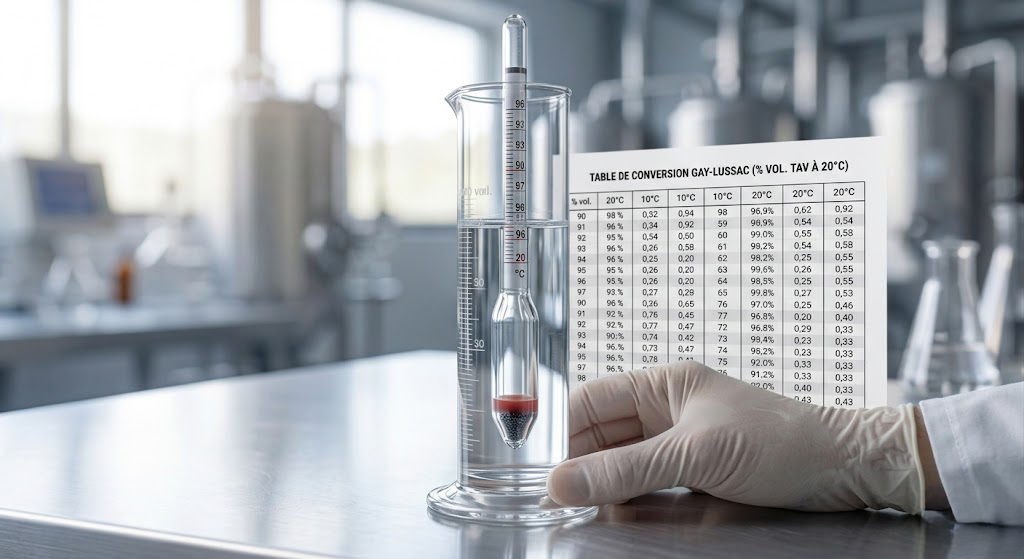
The physical phenomenon of contraction
A water-ethanol mixture is not additive: the volumes do not simply add up.
When mixed, water and alcohol molecules arrange themselves differently, which reduces the total volume.
Direct consequence
If you mix 50 liters of pure ethanol with 50 liters of water, you will not get 100 liters of solution, but about
96.3 liters.
Industrial impact
Ignoring this contraction distorts:
- yield calculations,
- material inventories
- and, ultimately, tax returns (excise).
The thermal variable: why 20°C matters
ABV is legally defined at a reference temperature of 20°C.
Yet the density of alcohol varies significantly with temperature.
Expansion
An alcohol measured at 25°C will show a higher apparent strength than its
real strength at 20°C.
Heating of the mixture
Dilution releases heat.
This rise in temperature can distort an immediate hydrometer reading. It is therefore necessary to let the mixture stabilize or to use correction tables.
The reference tool: the Gay-Lussac table
The rule of three is unsuitable because it assumes that volumes are additive.
In practice, professionals use dilution and contraction tables (EEC Regulation No. 2676/90).
These tables make it possible to determine:
- the exact volume of water to add to a given volume of alcohol to reach the target strength;
- the real final volume after contraction.
A concrete example:
To go from
100 liters of alcohol at 96% vol. to a strength of
40% vol. at 20°C:
- Incorrect theoretical calculation: (96/40)×100 = 240 liters in total (i.e. 140 liters of water to add).
- Technical reality (dilution table): You need to add 144.4 liters of water. The 4.4-liter difference compensates for the volume contraction so as to obtain exactly 240 liters of finished product at the desired strength.
Precautions regarding the quality of the reducing water
Dilution also affects the physico-chemical stability of the product.
Using water that is not demineralized or poorly filtered can lead to:
- Precipitation of mineral salts (calcium, magnesium).
- The “louche” effect (clouding), caused by the precipitation of certain compounds that become insoluble at low strength.
Practical note: the final adjustment
It is recommended to carry out the reduction in two stages:
- a first dilution to approach the target strength,
- a rest period of 24 to 48 hours to allow the mixture and the temperature to stabilize,
- a final adjustment of the alcoholic strength.