For a quality manager, an industrial buyer or an inventory manager, the
shelf life of a high-proof ethyl alcohol is a practical question.
It may come up during a stock count, before putting an old batch back into production, or as part of a
quality audit (ISO 9001, ISO 22000 or customer audit).
Answering it means separating two subjects:
the natural physicochemical stability of ethanol, and the documented guarantee attached to the product delivered.
An
extra neutral alcohol at 96% vol. is a stable raw material. It does not behave like a fragile or microbiologically sensitive product.
However, its quality can change if storage conditions are not controlled: a poorly closed container, exposure to heat, direct light, humidity, repeated opening, or prolonged storage in unsuitable packaging.
Best-before date, shelf life, retest date: what these terms mean
Depending on the supplier documents, several wordings may be used:
- Best-Before Date (BBD),
- recommended shelf life,
- retest date,
- period during which the specifications are guaranteed.
These terms must not be confused with a use-by date.
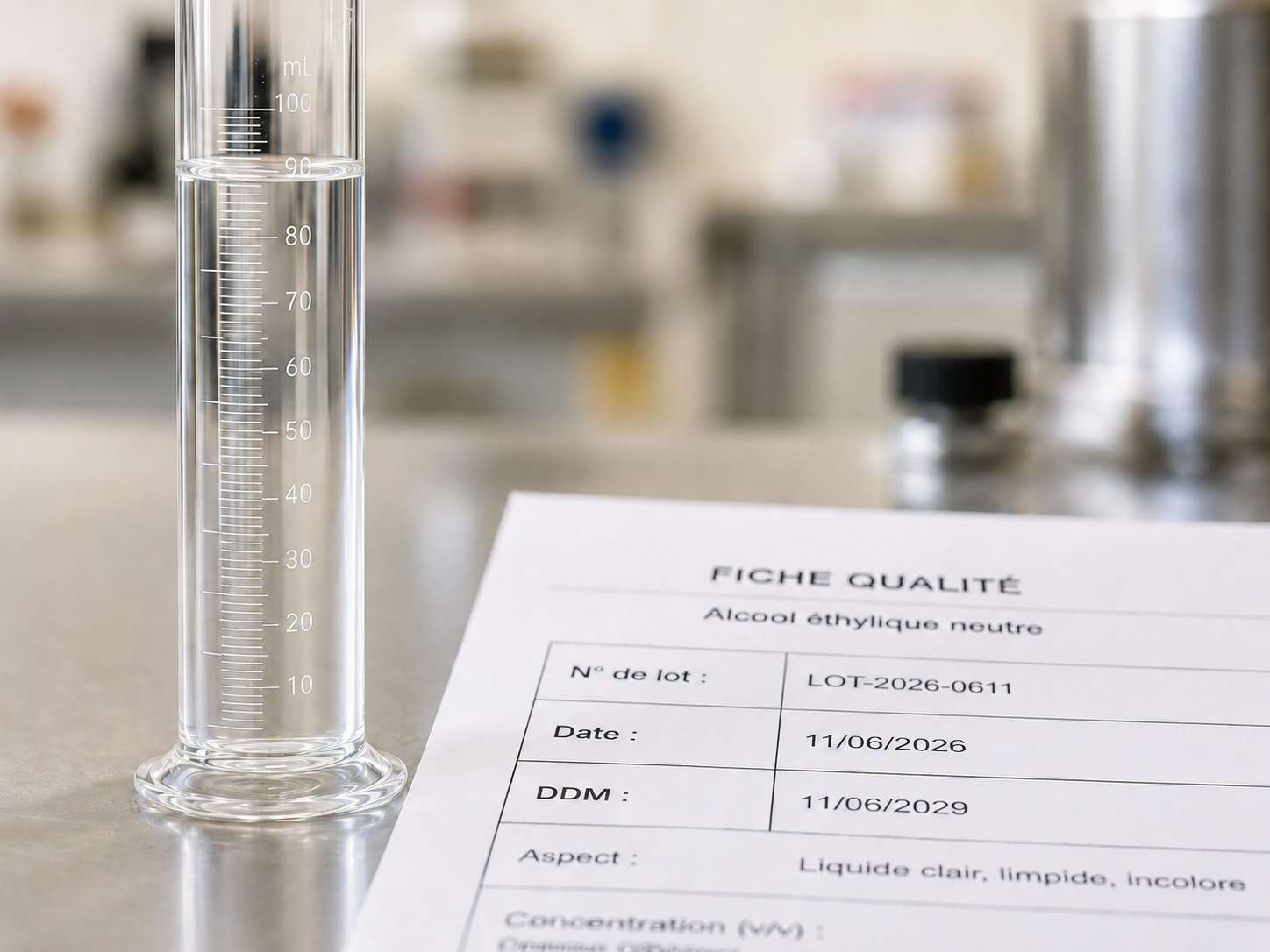
They indicate that the supplier guarantees the product's characteristics (alcoholic strength by volume, appearance, organoleptic neutrality, analytical compliance) up to a given date,
provided it is stored properly.
At Nadal Alcools, the best-before date stated on our technical data sheets is 3 years.
This does not mean the alcohol automatically becomes unusable after that period; it is a quality benchmark.
Once that date has passed, the right reflex is to check that the batch has kept its characteristics and is still suited to the intended use.
In practice, the alcohols we deliver to our customers are generally used within weeks or months of delivery.
Long-term storage therefore mainly concerns dormant stock, production leftovers, or raw materials kept in reserve.
A stable alcohol, but sensitive to its environment
Ethanol at 96% vol. has very good physicochemical stability.
Its high alcohol content strongly limits microbiological growth.
This is one of the reasons why ethyl alcohol is used as a solvent, preservative, formulation base or raw material in many professional sectors.
This stability does not do away with the need for careful management.
Several phenomena can gradually change the characteristics of an extra neutral alcohol, a wine alcohol, an agricultural alcohol or a denatured alcohol.
1. Hygroscopy: moisture can make the alcoholic strength drift
Ethanol is hygroscopic: it has a natural affinity for water.
In practice, this means that a high-proof alcohol can absorb a small amount of moisture if the container is not properly closed or is opened too often.
An IBC whose valve is not fully locked, an insufficiently tightened bung on a 200 L drum, or a container stored in a humid environment can encourage these exchanges with the surrounding air.
Over time, this water absorption can lead to a
measurable drop in alcoholic strength by volume (ABV).
For some uses, the impact remains limited.
However, for more demanding applications (
cosmetic formulation, perfumery, flavorings, spirits, pharmaceuticals or manufacturing under strict specifications), this drift can become a problem.
Checking the alcoholic strength therefore remains one of the simplest and most useful checks before putting an old batch back into production.
2. Volatility: evaporation can go unnoticed
Ethanol is a volatile liquid.
Its vapor pressure explains why slow evaporation can occur, even without any visible leak.
A micro-leak on an IBC valve, a worn gasket on a drum or a damaged bung does not always cause visible leakage.
Yet
a gradual loss may be occurring.
The consequences can be several:
- loss of volume,
- change in alcoholic strength,
- a shift in the ratio between ethanol and denaturing agents, in the case of a denatured alcohol.
This point is particularly important for buffer stocks, opened drums, IBCs opened several times, or batches kept between two production runs.
3. Heat, light and oxidation: preserving organoleptic neutrality
A room exposed to large temperature swings, a storage area in full sun, or translucent containers placed behind a glass roof are not ideal conditions for keeping an alcohol over time.
Heat increases vapor pressure and encourages evaporation.
Direct light, especially on containers with little opacity, can promote minor oxidation reactions and gradually alter the product's organoleptic neutrality.
For sectors where this neutrality,
the alcohol's "sensory silence", is a major compliance criterion (notably perfumery, cosmetics, flavorings and spirits), this drift can call into question whether the batch is still suited to its intended use.
4. Container-product compatibility: matching the packaging to the storage period
UN-approved, food-grade cans, 200 L drums and 1000 L IBCs are perfectly suited to the transport and routine storage of ethyl alcohols, provided they are compatible with the product, properly closed and kept in good conditions.
For prolonged storage or strategic volumes,
fixed stainless steel tanks remain the most robust solution. They offer excellent compatibility with ethanol, complete protection from light, and easier management of batches, sampling and checks.
The choice of container must therefore match the nature of the stock: rotating stock, buffer stock, safety stock, production leftovers, or raw material kept over a long period.
Good warehouse storage practices
To
keep an extra neutral alcohol in good condition, several rules must be followed:
- close containers tightly after each withdrawal;
- check that bungs are tight, gaskets are in good condition and IBC valves are locked;
- limit repeated opening of dormant stock;
- store away from direct light;
- avoid high heat and large temperature swings;
- keep products in a ventilated room suited to flammable liquids;
- comply with the rules that apply to alcohol storage: containment, signage, distance from ignition sources, ICPE regulations (French classified facilities) depending on the volumes stored;
- clearly identify batches and receipt dates
- check the strength, appearance and odor before putting an old batch back into production.
These good practices are a matter of
quality, traceability and safety alike.
Ethyl alcohol remains a flammable liquid, and its storage and handling must strictly comply with the requirements that apply to each site.
What should you do with an old batch?
A batch that is approaching or past its best-before date should not be discarded automatically.
The right approach is to reason according to the end use.
For a less sensitive use, checking the strength, appearance and odor may be enough.
For a more demanding application (cosmetics, perfumery, flavorings, spirits, pharmaceuticals or formulation under customer specifications), an additional laboratory analysis may be preferable.
An alcohol intended for production must not merely be "still good." It must remain strictly compliant with the expected specifications and suited to the finished product.
In summary
An extra neutral alcohol at 96% vol. is a stable raw material.
It does not carry the same expiry risks as a microbiologically sensitive product.
So the real question is not just:
"Has the alcohol expired?" The right question is:
"Has the batch kept its characteristics, and is it still suited to my use?"
At Nadal Alcools, the best-before date stated on our technical data sheets is 3 years, provided, of course, that the product is stored properly.
Beyond that period, the alcohol is not automatically unusable, but its use should be confirmed by a check suited to how demanding your application is.
With a
suitable container, careful closing after each withdrawal, protection from heat and light, and structured batch management, an extra neutral alcohol or a denatured alcohol can keep its original characteristics in excellent condition.
Do you have
a batch to retest or a question about the storage conditions for your ethyl alcohol?
Contact us: our team will help you choose the packaging, define the storage conditions and plan the checks suited to your use, from cans to bulk tanker deliveries.