
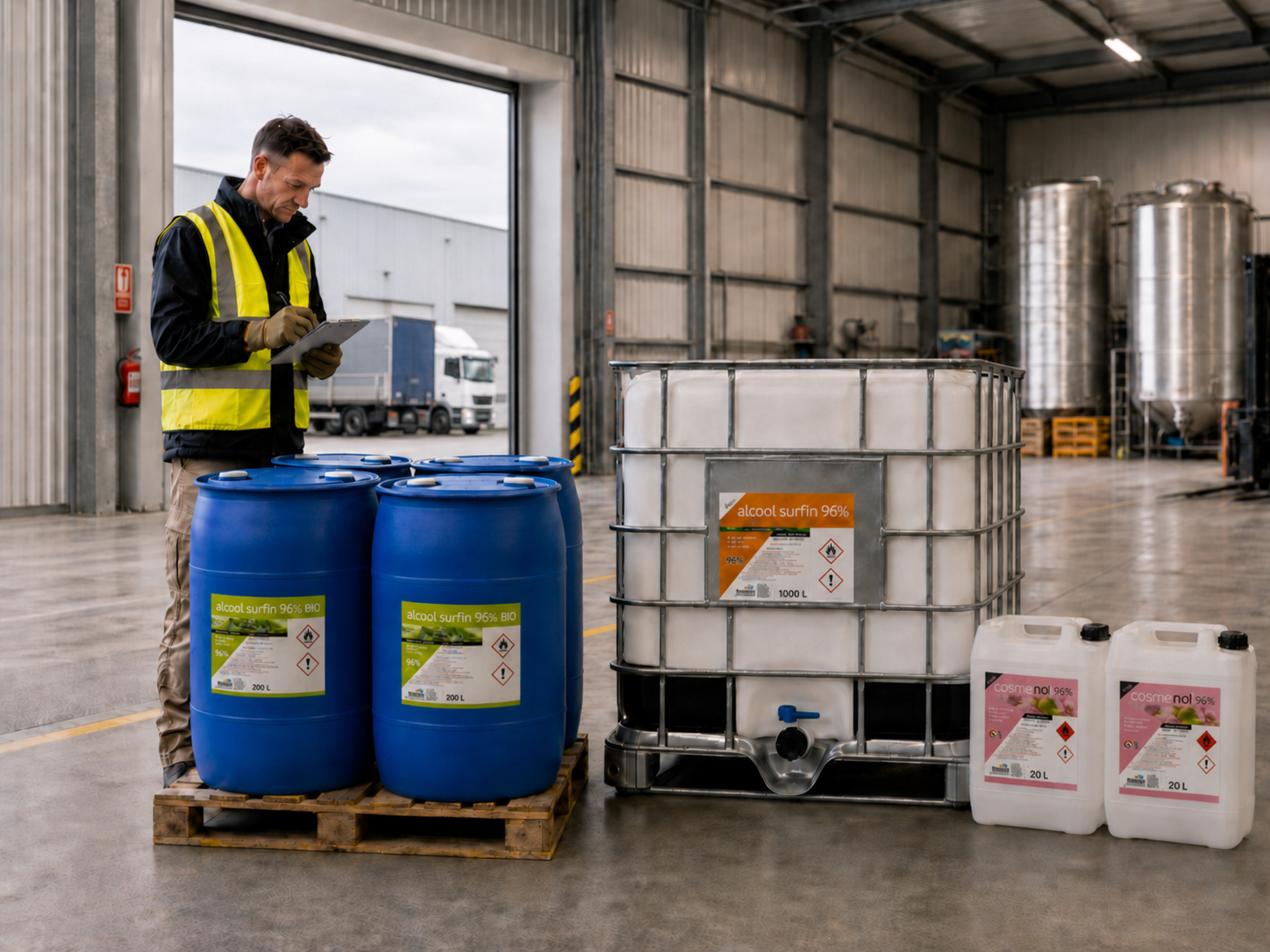
Before delivery: make sure the site can receive the goods
A successful delivery starts well before the truck arrives. Transporting dangerous goods imposes constraints that your site must be able to handle.Check site accessibility
Make sure that the delivery address is accurate and accessible to rigid trucks or semi-trailers. A narrow dead end or a weight restriction can lead to a costly failed delivery.Plan unloading equipment ahead
Specify when ordering whether you have a loading dock or whether a truck with a liftgate is needed. A 1000-liter IBC cannot be handled without a suitable pallet jack or forklift.Organize the receipt
Set clear time slots and make sure that a trained person is present to receive the goods and sign the transport documents.During receipt: check before you sign
When the goods arrive, take the time to check them before signing the delivery receipt.Check quantities
Make sure the number of packages (cans, pallets or drums) exactly matches the delivery note.Inspect the containers
Examine each container carefully. A deformed can, a cracked IBC valve or any seepage must be reported immediately. The note “subject to unpacking” has no legal value. State the exact damage (for example: “1 punctured 200-liter drum”) on the receipt and notify us immediately so that we can initiate the necessary procedures.After receipt: store without improvising
Once unloaded, your products must be moved to their storage area. Neutral alcohol is a sensitive product that does not tolerate improvisation. It must be stored according to safety rules and common sense.Choose a suitable environment
Opt for a ventilated room, away from direct light and from any source of heat or sparks.Preserve product quality
Plastic packaging (HDPE) offers excellent logistical solutions, but it does not replace the neutrality of stainless steel for very long-term storage. Be sure to close containers tightly after each draw to prevent evaporation and moisture absorption.Apply the FIFO method
Apply the “First In, First Out” (FIFO) rule to ensure the freshness of your batches, especially for alcohols of agricultural origin, as well as optimal traceability.Documentation: the key to your traceability
Accompanying documents should not be seen as a mere administrative formality. They are the guarantors of your compliance.ISO and HACCP traceability
Carefully keep your delivery notes, invoices and batch numbers. They are essential for your food safety audits and quality certifications.Safety and SDS
Make sure that the Safety Data Sheets (SDS) are accessible to the operators handling the product.Customs obligations
For alcohols moving under duty suspension, the DAE (electronic administrative document, e-AD) must be properly tracked and discharged on GAMMA within the required time frame. This step confirms that the goods have indeed reached their consignee and closes the movement in the customs system. For alcohols moving under another arrangement, particularly under exemption or with a specific accompanying document, the principle remains the same: documents must be kept, matched against the delivery received and rigorously archived.The Nadal Alcools advantage: simplified logistics
Because we know the constraints of your business, we have designed our service to remove logistical barriers. At Nadal Alcools, transport is included in our offers to give customers a clear view of the delivered cost and avoid unpleasant logistical surprises. We ask you in advance about:- the delivery location,
- the unloading equipment available,
- access constraints.
- 5 or 20-liter cans,
- 200-liter drums,
- 1000-liter IBCs,
- tanker delivery,
Receiving alcohol methodically means securing your production from the moment the goods arrive.